JavaScript/Node.js Patterns: Architecture Patterns and Decision Framework (2025)
Introduction
Understanding the architectural patterns and design decisions behind Javascriptnodejs Patterns is crucial for building maintainable, scalable, and robust JavaScript applications. This article provides a systematic decision framework for common architectural challenges in JavaScript development.

Series Context: This is Part 1 of the Javascriptnodejs Patterns specialized series. Part 2 covers hands-on implementation, and Part 3 addresses operations and optimization.
Architecture Decision Framework
Pattern Selection Criteria
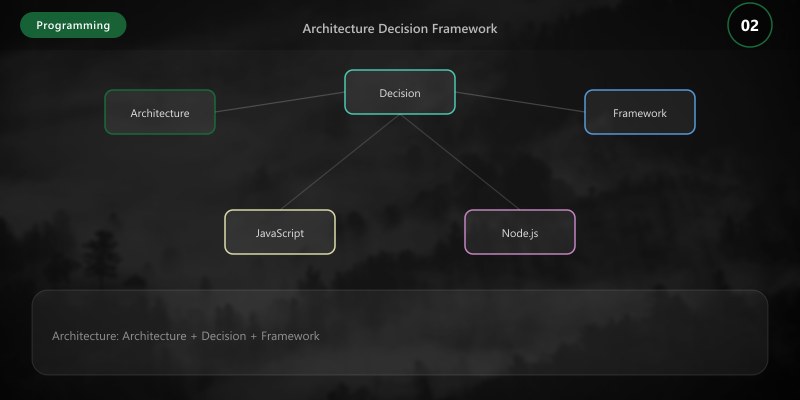
When choosing architectural patterns for JavaScript applications, evaluate each option against these criteria:
| Criterion | Weight | Questions to Ask |
|---|---|---|
| Maintainability | 25% | Can a new team member understand this in a day? |
| Testability | 20% | Can each component be tested in isolation? |
| Performance | 20% | Does this add unnecessary overhead? |
| Scalability | 15% | Will this work at 10x current load? |
| Team familiarity | 10% | Does the team know this pattern? |
| Ecosystem support | 10% | Are there libraries and tools for this? |
Core Architectural Patterns
Pattern 1: Layered Architecture
The most common pattern for JavaScript applications, organizing code into distinct layers:
Architecture Overview: Presentation Layer HTTP handlers, CLI, UI
When to Use: Standard CRUD applications, team-oriented projects, regulated environments.
Tradeoffs: Simple to understand (+), can become rigid (-), easy to enforce boundaries (+).
Pattern 2: Hexagonal / Ports & Adapters
Isolates business logic from external concerns for maximum testability:
Architecture Overview: ► HTTP ◄
When to Use: Complex domain logic, high test coverage requirements, long-lived applications.
Pattern 3: Event-Driven Architecture
Components communicate through events for loose coupling:
When to Use: Microservices, real-time systems, workflows with multiple side effects.
JavaScript Project Structure
Recommended Directory Layout
Architecture Overview: project root
Code Quality Patterns
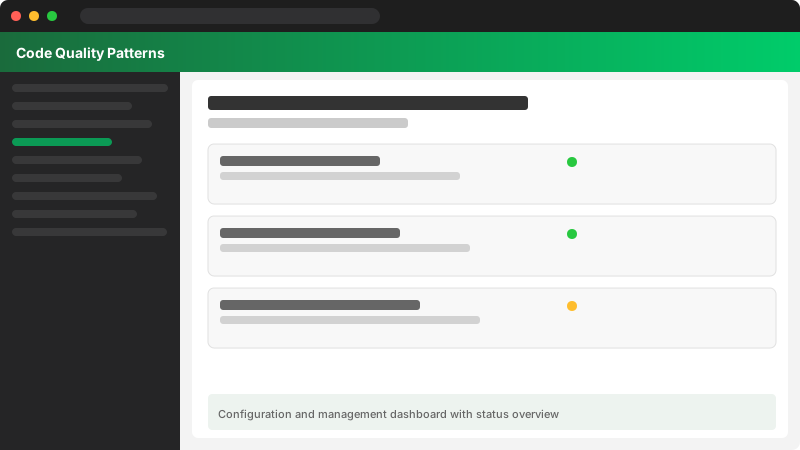
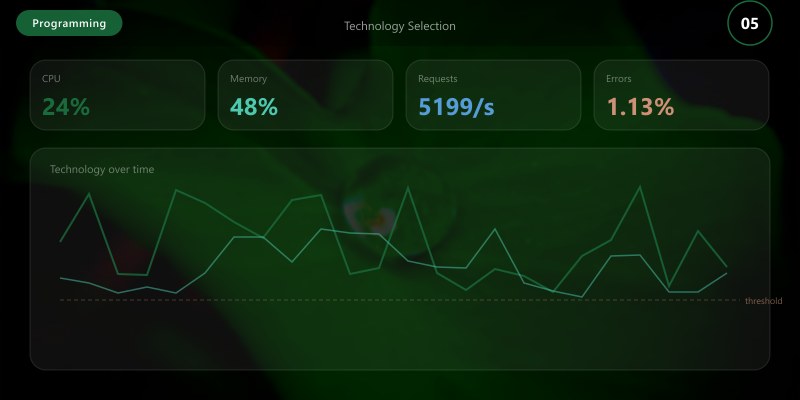
Figure: Configuration and management dashboard with status overview.
// Modern JavaScript patterns: classes, async/await, modules
export class DataService {
#baseUrl;
#cache = new Map();
#cacheTTL;
constructor(baseUrl, cacheTTL = 300000) {
this.#baseUrl = baseUrl;
this.#cacheTTL = cacheTTL;
}
async fetch(endpoint, options = {}) {
const cacheKey = endpoint + JSON.stringify(options);
const cached = this.#cache.get(cacheKey);
if (cached && Date.now() - cached.timestamp < this.#cacheTTL) {
return cached.data;
}
const controller = new AbortController();
const timeout = setTimeout(() => controller.abort(), 10000);
try {
const response = await fetch(this.#baseUrl + endpoint, {
...options,
signal: controller.signal,
headers: {
'Content-Type': 'application/json',
...options.headers
}
});
if (!response.ok) {
throw new Error('HTTP ' + response.status + ': ' + response.statusText);
}
const data = await response.json();
this.#cache.set(cacheKey, { data, timestamp: Date.now() });
return data;
} finally {
clearTimeout(timeout);
}
}
clearCache() {
this.#cache.clear();
}
}
// Functional utilities
export const pipe = (...fns) => (x) => fns.reduce((v, f) => f(v), x);
export const compose = (...fns) => (x) => fns.reduceRight((v, f) => f(v), x);
export const debounce = (fn, delay) => {
let timer;
return (...args) => {
clearTimeout(timer);
timer = setTimeout(() => fn(...args), delay);
};
};
export const retry = async (fn, maxAttempts = 3, delay = 1000) => {
for (let attempt = 1; attempt <= maxAttempts; attempt++) {
try {
return await fn();
} catch (error) {
if (attempt === maxAttempts) throw error;
await new Promise(r => setTimeout(r, delay * Math.pow(2, attempt - 1)));
}
}
};
Design Decisions in This Code
- Single Responsibility: Each class/struct has one clear purpose
- Dependency Injection: External dependencies are injected, not created internally
- Explicit Error Handling: Failures are communicated clearly to callers
- Immutability: Data is immutable by default, mutations are explicit
Technology Selection
| Category | Options | Recommendation |
|---|---|---|
| HTTP Framework | Standard library, popular frameworks | Start with stdlib, add framework if needed |
| Database Access | ORM, query builder, raw SQL | Query builder for most projects |
| Testing | Node.js test runner or Jest for testing | Use standard testing tools |
| Logging | Structured logging library | JSON-formatted, leveled logging |
| Configuration | Environment variables + config files | 12-factor app approach |
Risk Assessment
| Risk | Mitigation |
|---|---|
| Over-engineering | Start simple, refactor when complexity warranted |
| Vendor lock-in | Abstract external dependencies behind interfaces |
| Performance issues | Profile early, benchmark critical paths |
| Technical debt | Regular refactoring sprints, enforce code review |

Validation and Versioning
- Last validated: April 2026
- Validate examples against your tenant, region, and SKU constraints before production rollout.
- Keep module, CLI, and SDK versions pinned in automation pipelines and review quarterly.
Security and Governance Considerations
- Apply least-privilege access using RBAC roles and just-in-time elevation for admin tasks.
- Store secrets in managed secret stores and avoid embedding credentials in scripts or source files.
- Enable audit logging, data protection policies, and periodic access reviews for regulated workloads.
Cost and Performance Notes
- Define budgets and alerts, then monitor usage and cost trends continuously after go-live.
- Baseline performance with synthetic and real-user checks before and after major changes.
- Scale resources with measured thresholds and revisit sizing after usage pattern changes.
Official Microsoft References
- https://learn.microsoft.com/
- https://learn.microsoft.com/azure/
- https://learn.microsoft.com/power-platform/
- https://learn.microsoft.com/microsoft-365/
Public Examples from Official Sources
- These examples are sourced from official public Microsoft documentation and sample repositories.
- Documentation examples: https://learn.microsoft.com/training/
- Sample repositories: https://github.com/microsoft
- Prefer adapting these examples to your tenant, subscriptions, and governance requirements before production use.
Key Takeaways
- ✅ Choose architecture based on team needs and project complexity, not trends
- ✅ Start with the simplest pattern that works and evolve as requirements clarify
- ✅ JavaScript idioms often suggest the right pattern — follow language conventions
- ✅ Testability is a primary architectural driver, not an afterthought
- ✅ Document decisions in ADRs so future team members understand the context
Additional Resources
Part 1 of the Javascriptnodejs Patterns series (2025). Continue with Implementation Blueprint for hands-on guidance.