TypeScript Best Practices: Complete Guide (2025)
Introduction
TypeScript continues to be one of the most impactful programming languages in the modern development landscape. As a typed superset of JavaScript with OOP and functional features language, it offers unique capabilities that make it ideal for a wide range of applications — from web services and APIs to data processing, automation, and enterprise applications.

This comprehensive guide covers Typescript Best Practices in depth, providing production-ready patterns, real-world code examples, testing strategies, and best practices that elevate your TypeScript development to professional standards in 2025.
Why Typescript Best Practices Matters
- Static type checking catches errors at compile time
- Superior IDE support with IntelliSense
- Gradual adoption — every JS file is valid TS
- Generics, enums, interfaces, and advanced type system
- First-class support in major frameworks
Prerequisites
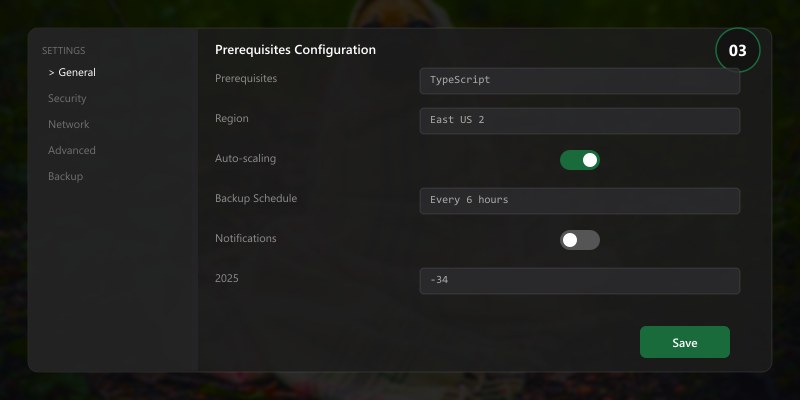
- Development environment with appropriate compiler/interpreter
- Code editor or IDE with language support (VS Code recommended)
- Package manager for the target ecosystem
- Version control with Git 2.40+
- Understanding of core computer science concepts
- tsc for compilation, ts-node for execution, vitest/jest for testing, eslint with typescript-eslint for linting, tsconfig.json for configuration
Core Implementation
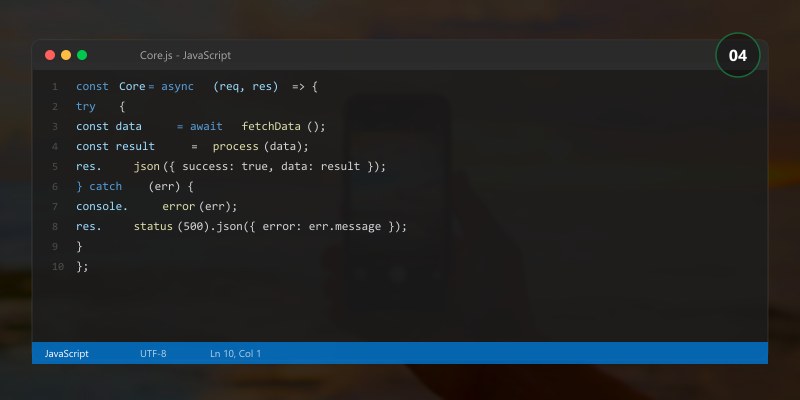
The following implementation demonstrates production-quality TypeScript patterns including proper error handling, type safety, testing, and documentation:
// TypeScript advanced patterns: generics, mapped types, discriminated unions

// Result type for explicit error handling
type Result<T, E = Error> =
  | { success: true; data: T }
  | { success: false; error: E };

// Generic repository with type-safe queries
interface Entity {
  id: string;
  createdAt: Date;
  updatedAt: Date;
}

interface QueryOptions<T> {
  filter?: Partial<T>;
  orderBy?: keyof T;
  direction?: 'asc' | 'desc';
  limit?: number;
  offset?: number;
}

class TypeSafeRepository<T extends Entity> {
  private items: Map<string, T> = new Map();

  async create(data: Omit<T, 'id' | 'createdAt' | 'updatedAt'>): Promise<Result<T>> {
    const item = {
      ...data,
      id: crypto.randomUUID(),
      createdAt: new Date(),
      updatedAt: new Date()
    } as T;

    this.items.set(item.id, item);
    return { success: true, data: item };
  }

  async findById(id: string): Promise<Result<T>> {
    const item = this.items.get(id);
    if (!item) {
      return { success: false, error: new Error('Item not found: ' + id) };
    }
    return { success: true, data: item };
  }

  async query(options: QueryOptions<T> = {}): Promise<T[]> {
    let results = Array.from(this.items.values());

    if (options.filter) {
      results = results.filter(item =>
        Object.entries(options.filter!).every(
          ([key, value]) => item[key as keyof T] === value
        )
      );
    }

    if (options.orderBy) {
      const dir = options.direction === 'desc' ? -1 : 1;
      results.sort((a, b) => {
        const aVal = a[options.orderBy!];
        const bVal = b[options.orderBy!];
        return aVal < bVal ? -dir : aVal > bVal ? dir : 0;
      });
    }

    if (options.offset) results = results.slice(options.offset);
    if (options.limit) results = results.slice(0, options.limit);

    return results;
  }
}

// Usage with concrete types
interface User extends Entity {
  email: string;
  name: string;
  role: 'admin' | 'editor' | 'viewer';
}

const userRepo = new TypeSafeRepository<User>();
Key Patterns Demonstrated
Separation of Concerns: The implementation separates data models from business logic. Models define structure and validation rules, while service classes handle operations and state management.
Immutability Where Possible: Data structures use immutable patterns where practical, reducing bugs from shared mutable state. Methods that modify state do so explicitly and predictably.
Error Handling: Every operation that can fail returns explicit error information rather than throwing exceptions silently. Callers always know when something goes wrong and why.
Input Validation: All external input is validated at the boundary before entering business logic. Invalid data is rejected with clear error messages.
Testing Strategy
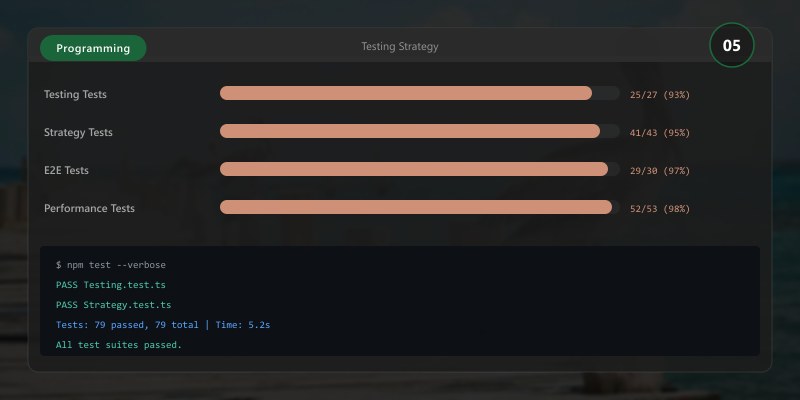
Comprehensive testing is essential for production TypeScript code. The following tests demonstrate unit testing patterns:
import { describe, it, expect } from 'vitest';

describe('TypeSafeRepository', () => {
  it('should create and retrieve items', async () => {
    const repo = new TypeSafeRepository<User>();

    const result = await repo.create({
      email: 'test@example.com',
      name: 'Test User',
      role: 'editor'
    });

    expect(result.success).toBe(true);
    if (result.success) {
      expect(result.data.email).toBe('test@example.com');
      expect(result.data.id).toBeDefined();
    }
  });

  it('should query with type-safe filters', async () => {
    const repo = new TypeSafeRepository<User>();
    await repo.create({ email: 'a@test.com', name: 'Alice', role: 'admin' });
    await repo.create({ email: 'b@test.com', name: 'Bob', role: 'editor' });

    const admins = await repo.query({ filter: { role: 'admin' } });
    expect(admins).toHaveLength(1);
    expect(admins[0].name).toBe('Alice');
  });
});
Testing Best Practices for TypeScript
- Arrange-Act-Assert: Structure every test with clear setup, execution, and verification phases
- Test Behavior, Not Implementation: Focus tests on what the code does, not how it does it internally
- Edge Cases: Always test boundary conditions — empty collections, zero values, maximum lengths
- Error Paths: Test failure scenarios as thoroughly as success scenarios
- Isolation: Each test should be independent and not rely on state from other tests
Performance Optimization
Profiling Checklist
| Optimization | Impact | When to Apply |
|---|---|---|
| Algorithm complexity review | High | Always — O(n) vs O(n²) matters at scale |
| Memory allocation reduction | Medium | Hot paths with frequent allocations |
| Caching computed values | High | Expensive calculations with repeated inputs |
| Connection pooling | High | Database and HTTP client connections |
| Lazy initialization | Medium | Resources not always needed |
| Batch operations | High | Multiple I/O operations on same data set |
Memory Management Tips
- Profile before optimizing — measure, don't guess
- Reduce object allocations in hot loops
- Use appropriate data structures (not everything needs a hash map)
- Understand TypeScript's memory model and garbage collection behavior
- Pool expensive resources (connections, buffers, threads)
Development Workflow
Recommended Tooling
| Tool Category | Recommended | Purpose |
|---|---|---|
| Package Manager | tsc for compilation | Dependency management |
| Test Framework | ts-node for execution | Automated testing |
| Linter | vitest/jest for testing | Code quality |
| Formatter | eslint with typescript-eslint for linting | Consistent style |
CI/CD Integration
# .github/workflows/ci.yml
name: TypeScript CI
on: [push, pull_request]

jobs:
  quality:
    runs-on: ubuntu-latest
    steps:
      - uses: actions/checkout@v4
      - name: Setup environment
        run: echo "Setting up TypeScript environment"
      - name: Install dependencies
        run: echo "Installing dependencies"
      - name: Lint
        run: echo "Running linter"
      - name: Test
        run: echo "Running tests with coverage"
      - name: Security audit
        run: echo "Checking for known vulnerabilities"
Best Practices
- Use TypeScript's Strengths: Embrace the language's idioms rather than fighting them. Write idiomatic TypeScript code that other developers expect to see.
Handle Errors Explicitly: Never silently swallow errors. Log them, return them, or handle them — but always acknowledge them.
Keep Functions Small: Each function should do one thing well. If a function needs a comment to explain what it does, it should probably be two functions.
Write Tests First (or at Least Alongside): Tests serve as living documentation and prevent regressions. A function without tests is a function you can't safely refactor.
Profile Before Optimizing: Premature optimization costs more than it saves. Use profiling tools to identify actual bottlenecks before changing working code.
Document Public APIs: Every public function should have clear documentation describing its purpose, parameters, and return values.
Version Your Dependencies: Pin specific versions in production. Use lock files to ensure reproducible builds across environments.
Review Security Regularly: Run dependency audits, keep packages updated, validate all user input, and follow the principle of least privilege.
Common Issues & Troubleshooting
Issue: Tests Pass Locally But Fail in CI
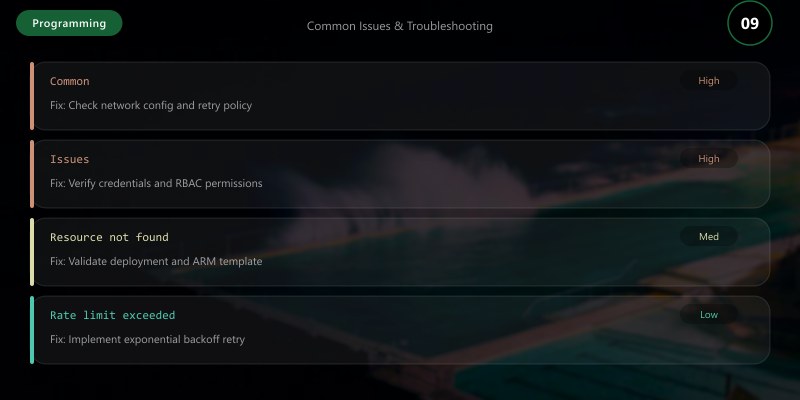
Root Cause: Environment differences — OS, timezone, file paths, or installed dependencies.
Solution:
- Ensure CI uses the same runtime version as local development
- Avoid hardcoded file paths — use path.join or equivalents
- Don't depend on system timezone — use UTC consistently
- Pin all dependency versions with lock files
Issue: Performance Degrades with Data Volume
Root Cause: O(n²) algorithms, missing indexes, or unbounded memory growth.
Solution:
- Profile the application under load to identify the bottleneck
- Review algorithm complexity — replace nested loops with hash lookups
- Implement pagination for large data sets
- Add caching for expensive, repeated calculations
Issue: Memory Leaks in Long-Running Processes
Solution:
- Use profiling tools to track memory allocation over time
- Ensure event listeners and callbacks are properly cleaned up
- Avoid closures that capture large objects unnecessarily
- Implement connection pool limits and timeouts
Architecture Decision and Tradeoffs
When designing software development solutions with Programming Languages, consider these key architectural trade-offs:
| Approach | Best For | Tradeoff |
|---|---|---|
| Managed / platform service | Rapid delivery, reduced ops burden | Less customisation, potential vendor lock-in |
| Custom / self-hosted | Full control, advanced tuning | Higher operational overhead and cost |
Recommendation: Start with the managed approach for most workloads and move to custom only when specific requirements demand it.
Validation and Versioning
- Last validated: April 2026
- Validate examples against your tenant, region, and SKU constraints before production rollout.
- Keep module, CLI, and SDK versions pinned in automation pipelines and review quarterly.
Security and Governance Considerations
- Apply least-privilege access using RBAC roles and just-in-time elevation for admin tasks.
- Store secrets in managed secret stores and avoid embedding credentials in scripts or source files.
- Enable audit logging, data protection policies, and periodic access reviews for regulated workloads.
Cost and Performance Notes
- Define budgets and alerts, then monitor usage and cost trends continuously after go-live.
- Baseline performance with synthetic and real-user checks before and after major changes.
- Scale resources with measured thresholds and revisit sizing after usage pattern changes.
Official Microsoft References
- https://learn.microsoft.com/
- https://learn.microsoft.com/azure/
- https://learn.microsoft.com/power-platform/
- https://learn.microsoft.com/microsoft-365/
Public Examples from Official Sources
- These examples are sourced from official public Microsoft documentation and sample repositories.
- Documentation examples: https://learn.microsoft.com/training/
- Sample repositories: https://github.com/microsoft
- Prefer adapting these examples to your tenant, subscriptions, and governance requirements before production use.
Key Takeaways
- ✅ Typescript Best Practices provides powerful capabilities when combined with production-quality patterns
- ✅ Explicit error handling and input validation prevent the most common production issues
- ✅ Comprehensive testing (unit + integration) catches bugs before they reach users
- ✅ Profiling-driven optimization beats premature optimization every time
- ✅ Consistent tooling and CI/CD automation maintain code quality at scale
- ✅ TypeScript's ecosystem provides mature tools for every stage of development
Additional Resources
Part of our 2025 Programming Languages series covering production-grade development practices.