TypeScript Best Practices: Architecture Patterns and Decision Framework (2025)
Introduction
Understanding the architectural patterns and design decisions behind Typescript Best Practices is crucial for building maintainable, scalable, and robust TypeScript applications. This article provides a systematic decision framework for common architectural challenges in TypeScript development.

Series Context: This is Part 1 of the Typescript Best Practices specialized series. Part 2 covers hands-on implementation, and Part 3 addresses operations and optimization.
Architecture Decision Framework
Pattern Selection Criteria
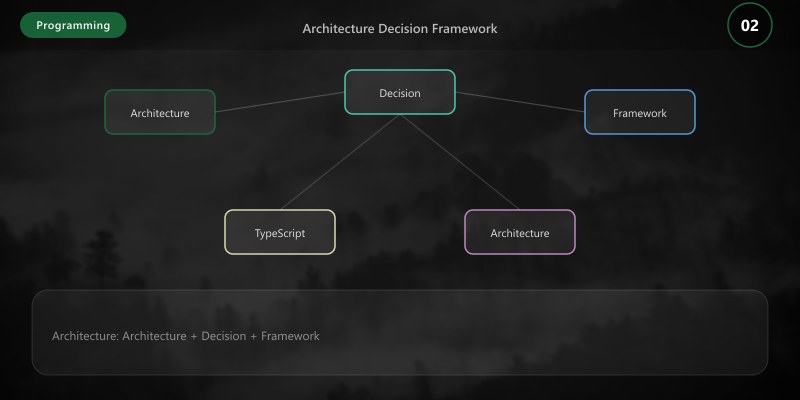
When choosing architectural patterns for TypeScript applications, evaluate each option against these criteria:
| Criterion | Weight | Questions to Ask |
|---|---|---|
| Maintainability | 25% | Can a new team member understand this in a day? |
| Testability | 20% | Can each component be tested in isolation? |
| Performance | 20% | Does this add unnecessary overhead? |
| Scalability | 15% | Will this work at 10x current load? |
| Team familiarity | 10% | Does the team know this pattern? |
| Ecosystem support | 10% | Are there libraries and tools for this? |
Core Architectural Patterns
Pattern 1: Layered Architecture
The most common pattern for TypeScript applications, organizing code into distinct layers:
Architecture Overview: Presentation Layer HTTP handlers, CLI, UI
When to Use: Standard CRUD applications, team-oriented projects, regulated environments.
Tradeoffs: Simple to understand (+), can become rigid (-), easy to enforce boundaries (+).
Pattern 2: Hexagonal / Ports & Adapters
Isolates business logic from external concerns for maximum testability:
Architecture Overview: ► HTTP ◄
When to Use: Complex domain logic, high test coverage requirements, long-lived applications.
Pattern 3: Event-Driven Architecture
Components communicate through events for loose coupling:
When to Use: Microservices, real-time systems, workflows with multiple side effects.
TypeScript Project Structure
Recommended Directory Layout
Architecture Overview: project root
Code Quality Patterns
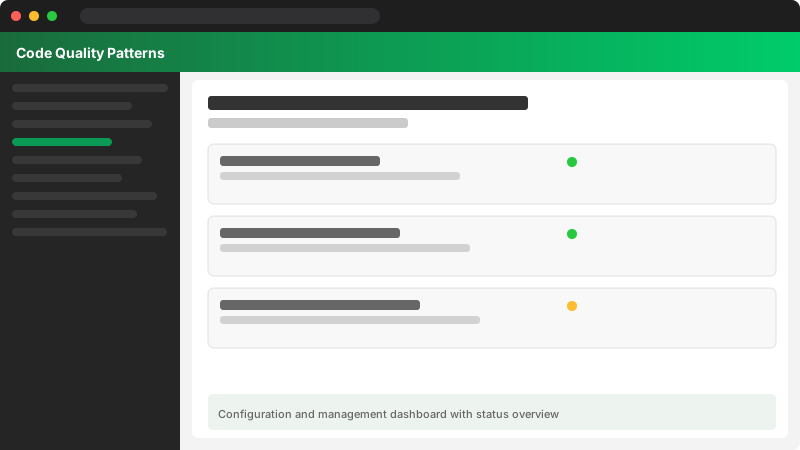
Figure: Configuration and management dashboard with status overview.
// TypeScript advanced patterns: generics, mapped types, discriminated unions
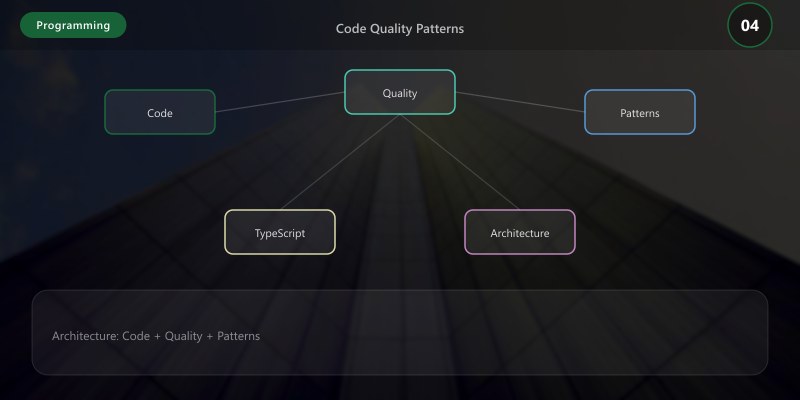
// Result type for explicit error handling
type Result<T, E = Error> =
| { success: true; data: T }
| { success: false; error: E };
// Generic repository with type-safe queries
interface Entity {
id: string;
createdAt: Date;
updatedAt: Date;
}
interface QueryOptions<T> {
filter?: Partial<T>;
orderBy?: keyof T;
direction?: 'asc' | 'desc';
limit?: number;
offset?: number;
}
class TypeSafeRepository<T extends Entity> {
private items: Map<string, T> = new Map();
async create(data: Omit<T, 'id' | 'createdAt' | 'updatedAt'>): Promise<Result<T>> {
const item = {
...data,
id: crypto.randomUUID(),
createdAt: new Date(),
updatedAt: new Date()
} as T;
this.items.set(item.id, item);
return { success: true, data: item };
}
async findById(id: string): Promise<Result<T>> {
const item = this.items.get(id);
if (!item) {
return { success: false, error: new Error('Item not found: ' + id) };
}
return { success: true, data: item };
}
async query(options: QueryOptions<T> = {}): Promise<T[]> {
let results = Array.from(this.items.values());
if (options.filter) {
results = results.filter(item =>
Object.entries(options.filter!).every(
([key, value]) => item[key as keyof T] === value
)
);
}
if (options.orderBy) {
const dir = options.direction === 'desc' ? -1 : 1;
results.sort((a, b) => {
const aVal = a[options.orderBy!];
const bVal = b[options.orderBy!];
return aVal < bVal ? -dir : aVal > bVal ? dir : 0;
});
}
if (options.offset) results = results.slice(options.offset);
if (options.limit) results = results.slice(0, options.limit);
return results;
}
}
// Usage with concrete types
interface User extends Entity {
email: string;
name: string;
role: 'admin' | 'editor' | 'viewer';
}
const userRepo = new TypeSafeRepository<User>();
Design Decisions in This Code
- Single Responsibility: Each class/struct has one clear purpose
- Dependency Injection: External dependencies are injected, not created internally
- Explicit Error Handling: Failures are communicated clearly to callers
- Immutability: Data is immutable by default, mutations are explicit
Technology Selection
| Category | Options | Recommendation |
|---|---|---|
| HTTP Framework | Standard library, popular frameworks | Start with stdlib, add framework if needed |
| Database Access | ORM, query builder, raw SQL | Query builder for most projects |
| Testing | ts-node for execution | Use standard testing tools |
| Logging | Structured logging library | JSON-formatted, leveled logging |
| Configuration | Environment variables + config files | 12-factor app approach |
Risk Assessment
| Risk | Mitigation |
|---|---|
| Over-engineering | Start simple, refactor when complexity warranted |
| Vendor lock-in | Abstract external dependencies behind interfaces |
| Performance issues | Profile early, benchmark critical paths |
| Technical debt | Regular refactoring sprints, enforce code review |
Validation and Versioning
- Last validated: April 2026
- Validate examples against your tenant, region, and SKU constraints before production rollout.
- Keep module, CLI, and SDK versions pinned in automation pipelines and review quarterly.
Security and Governance Considerations
- Apply least-privilege access using RBAC roles and just-in-time elevation for admin tasks.
- Store secrets in managed secret stores and avoid embedding credentials in scripts or source files.
- Enable audit logging, data protection policies, and periodic access reviews for regulated workloads.
Cost and Performance Notes
- Define budgets and alerts, then monitor usage and cost trends continuously after go-live.
- Baseline performance with synthetic and real-user checks before and after major changes.
- Scale resources with measured thresholds and revisit sizing after usage pattern changes.
Official Microsoft References
- https://learn.microsoft.com/
- https://learn.microsoft.com/azure/
- https://learn.microsoft.com/power-platform/
- https://learn.microsoft.com/microsoft-365/
Public Examples from Official Sources
- These examples are sourced from official public Microsoft documentation and sample repositories.
- Documentation examples: https://learn.microsoft.com/training/
- Sample repositories: https://github.com/microsoft
- Prefer adapting these examples to your tenant, subscriptions, and governance requirements before production use.
Key Takeaways
- ✅ Choose architecture based on team needs and project complexity, not trends
- ✅ Start with the simplest pattern that works and evolve as requirements clarify
- ✅ TypeScript idioms often suggest the right pattern — follow language conventions
- ✅ Testability is a primary architectural driver, not an afterthought
- ✅ Document decisions in ADRs so future team members understand the context
Additional Resources
Part 1 of the Typescript Best Practices series (2025). Continue with Implementation Blueprint for hands-on guidance.